

DC Drive vs AC Drive
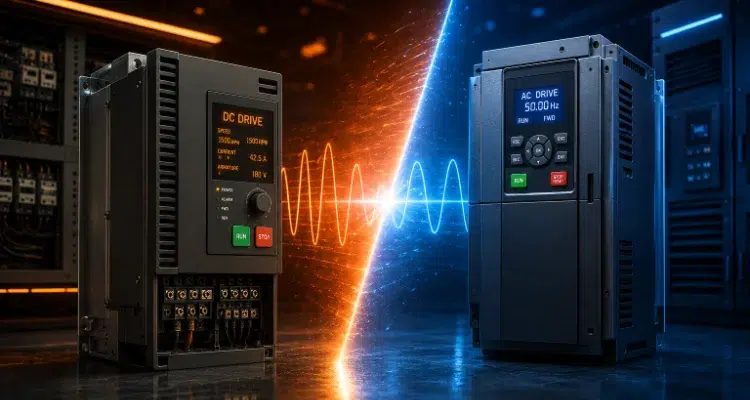
Here is where the practical decision gets made. Both technologies are mature and capable — the right choice depends on your motor type, application demands, environment, and long-term maintenance strategy.
Motor and Installation Complexity
AC induction motors are simpler in construction — no brushes, no commutator, fewer wearing parts. They are generally less expensive to purchase, easier to source, and more tolerant of harsh environments including dust, moisture, and corrosive atmospheres. AC drives do, however, require careful motor cable selection and sometimes output filters to manage harmonic and switching effects.
DC motors contain brushes and a commutator that require periodic inspection and replacement. In clean, accessible environments this is manageable, but in dusty, wet, or hazardous locations, brush maintenance becomes a real operational burden.
Maintenance and Total Cost of Ownership
This is often the deciding factor. AC systems have lower ongoing maintenance costs due to the brushless motor design. Over a 10–15-year horizon, the total cost of ownership of an AC system is generally lower than an equivalent DC system, largely because of reduced motor maintenance.
DC systems, however, have lower upfront conversion costs when motors are already in place, and their simplicity means that experienced maintenance teams can keep them running reliably for many years.
Performance and Control
Modern AC drives with closed-loop vector control have largely closed the performance gap with DC. For most industrial applications, AC drives now offer comparable torque response, speed regulation, and dynamic performance. However, for the most demanding applications — particularly those requiring full torque at zero speed without an encoder, or very wide speed ranges — DC still holds practical advantages in simplicity of setup.
Energy Efficiency
Both technologies are efficient in their own right, but AC induction motors typically have a slight efficiency advantage over equivalent DC motors at full load. The bigger efficiency gain, however, comes from using either drive type to match motor speed to actual process demand — rather than running at full speed and throttling mechanically.
Summary Comparison
| DC Drive | AC Drive | |
|---|---|---|
| Motor type | DC motor (brushed) | AC induction or synchronous motor |
| Torque at low/zero speed | Excellent | Very good (with vector control) |
| Speed regulation | Excellent | Very good to excellent |
| Motor maintenance | Higher (brushes/commutator) | Lower (brushless) |
| Motor cost | Higher | Lower |
| Harsh environment suitability | Moderate | High |
| Regenerative braking | Straightforward | Possible, requires additional hardware |
| Retrofit of existing DC motors | Ideal | High conversion cost |
| Long-term ownership cost | Higher | Lower |
| Best suited for | Existing DC installations, high-torque, precision winding/drawing | New installations, harsh environments, energy efficiency priority |
The Bottom Line
If you are specifying a new installation from scratch, AC drives paired with AC induction motors are the modern standard — they offer lower motor costs, lower maintenance, and excellent performance across a wide range of applications.
If you have existing DC motors in service, or if your application demands full torque at very low speeds and regenerative capability in a controlled environment, a DC drive remains a highly capable and cost-effective solution. Replacing working DC systems purely for the sake of technology is rarely justified.
The most important principle: match the drive technology to the motor you have and the process you need to run — not to a trend. Both DC and AC drive systems, properly specified and maintained, will serve you reliably for many years.
Explore Our Range


