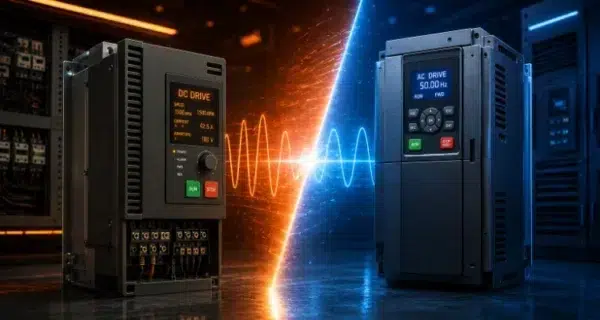
VSD vs Soft Starter: Which One Does Your Motor Actually Need?
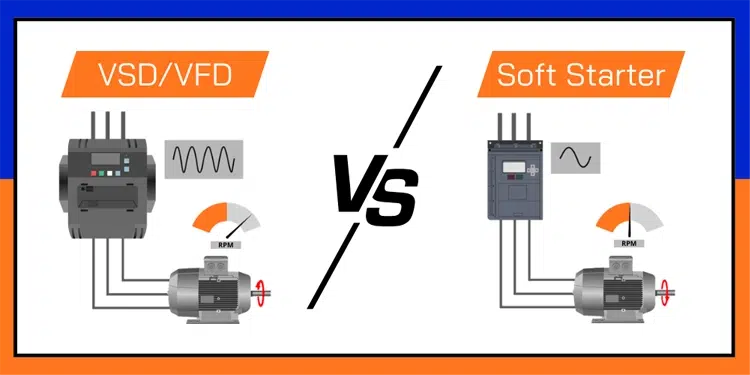
If you’ve ever had to specify motor control equipment for a new installation or retrofit, you’ve probably faced this question. Both variable speed drives (VSDs) and soft starters solve the problem of harsh motor starting — but they do very different jobs, and choosing the wrong one costs you either money or performance. Here’s a clear breakdown to help you decide.
The Core Difference
A soft starter does one thing well: it controls how a motor starts and stops. It gradually ramps up voltage to the motor during startup, reducing the mechanical shock and electrical inrush current that can damage equipment and trip protection devices. Once the motor reaches full speed, the soft starter essentially steps aside — the motor runs at full speed, full voltage, just like it would on a direct-on-line (DOL) starter.
A VSD (also called a variable frequency drive or VFD) does something fundamentally different: it controls the motor’s speed continuously, at any point during operation — not just at startup. It achieves this by varying both the frequency and voltage supplied to the motor, giving you precise speed control from near-zero to full speed and everywhere in between.
When a Soft Starter Makes Sense
Soft starters are the right choice when your application only needs controlled starting and stopping, and the motor will always run at full speed once it gets there.
Ideal applications:
- Pumps and fans where water hammer or belt stress at startup is the problem
- Compressors and conveyors that need smooth acceleration to protect mechanical components
- Applications with frequent starts and stops where DOL starting would cause wear
- Any situation where budget is tight and variable speed isn’t needed
Key advantages:
- Lower cost than a VSD — typically 30–50% less
- Simpler installation and commissioning
- Compact footprint
- Lower maintenance complexity
- Generates less harmonic distortion on the electrical network.
When a VSD Is the Right Tool
A VSD is essential whenever the process itself benefits from — or requires — variable speed during normal operation.
Ideal applications:
- Pumps and fans where flow needs to be regulated (rather than throttled with a valve or damper)
- Conveyor systems requiring precise speed matching across multiple drives
- Mixers, extruders, or process lines with variable load demands
- Any application where energy efficiency during running is a priority
- HVAC systems where air or water flow varies with demand
Key advantages:
- Continuous speed control throughout the full operating range
- Significant energy savings — reducing motor speed by 20% can cut energy consumption by nearly 50% (following the affinity laws for centrifugal loads)
- Smooth starting is included as a standard feature
- Enables process control without mechanical throttling
- Built-in protection functions (overload, phase loss, PTC motor protection)
The Bottom Line
If your motor always runs at full speed and you just need to protect it (and your mechanical system) at startup — a soft starter is the cost-effective, reliable choice.
If your process benefits from variable speed, or if energy efficiency during operation matters to your bottom line — a VSD will deliver better long-term value despite the higher purchase price.
In many real-world installations, especially pumps and fans running at partial load for significant portions of the day, the VSD pays for itself relatively quickly and continues saving money for the life of the installation.
Still unsure which option fits your specific application? Talk to One of our Sales Team. Contact us on Tel: 011 -433 8502 or sales@saftronics.co.za
Explore Our Range


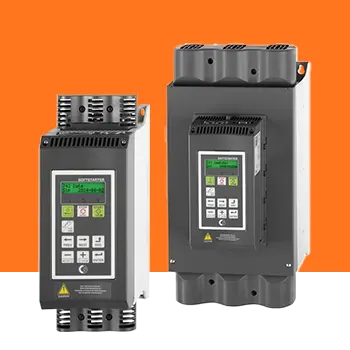
Emotron TSA
5.5 – 1000kW, 200 – 525V, IP20
.
Emotron TSA
5.5 – 1000kW, 200 – 525V, IP20
.