DC vs AC Motor Control: Understanding the Difference and Choosing the Right Drive

Motor control technology has evolved significantly over the past few decades, and today’s industrial market offers powerful options in both DC and AC drive systems. Yet the question of which to use — and when — still causes confusion. This article breaks down the key differences, helping you make a confident, informed decision for your application.
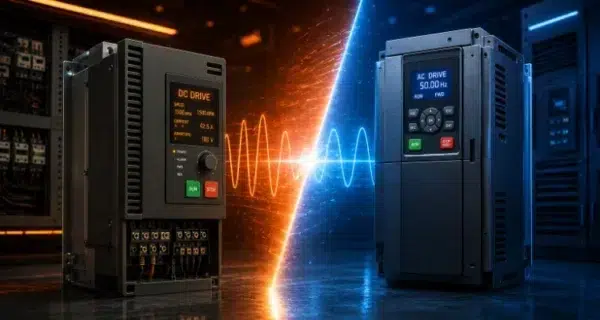
DC Motor Control
vs
AC Motor Control
At the heart of the comparison is the type of motor being controlled, and how speed and torque are managed.
DC motor control works by varying the voltage (and sometimes current) supplied to a DC motor. The speed of a DC motor is directly proportional to the armature voltage, while torque is controlled by armature current. This makes DC systems inherently straightforward to control — the relationship between input and output is linear and predictable. DC drives have been the workhorse of industrial speed control for decades, and many installed systems across South African industry are still DC-based.
AC motor control — typically implemented through a variable speed drive (VSD or VFD) — works differently. An AC drive converts incoming AC supply to DC internally, then inverts it back to a variable-frequency, variable-voltage AC output. By changing the frequency supplied to an AC induction motor, the drive controls the motor’s speed. Modern AC drives with vector control can also manage torque with a high degree of precision, closing much of the performance gap that once made DC the preferred choice for demanding applications.
The fundamental distinction: DC control is simpler in principle and has been refined over a long time. AC control is more complex electronically, but the motors themselves are simpler, more robust, and less expensive to maintain.
When to Use a DC Drive
Despite AC technology advancing rapidly, DC drives remain the right — and often the best — choice in a number of situations.
Existing DC motor installations.
This is the most common reason. If your facility already has DC motors installed and running — on a conveyor, a winder, a press, or a pump — replacing the entire motor and drive system is rarely justified on cost grounds alone. A modern DC drive retrofit extends the working life of your existing motor at a fraction of the cost of a full AC conversion.
High torque at low speed.
DC motors deliver full torque right down to zero speed without needing external feedback devices. For applications like hoists, cranes, extruders, and winders where maximum torque at standstill or very low speed is critical, DC drives offer a proven, reliable solution.
Regenerative braking applications.
Four-quadrant DC drives can return energy back to the supply during braking, making them highly efficient in applications with frequent acceleration and deceleration cycles, such as test rigs, dynamometers, and mine winders.
Precise speed regulation.
DC drives offer excellent speed holding accuracy, even under varying load conditions. Applications such as wire drawing, printing machinery, and paper or textile winding — where consistent, tight speed control is non-negotiable — have traditionally favoured DC.
Legacy systems and spares availability.
In industries where downtime is costly and engineering teams are already familiar with DC technology, continuity has real value. Replacing a DC drive with a like-for-like unit is fast, low-risk, and keeps proven processes running.
Explore Our Range