

How Does a Tachogenerator Work? The Complete Guide to Speed Sensing
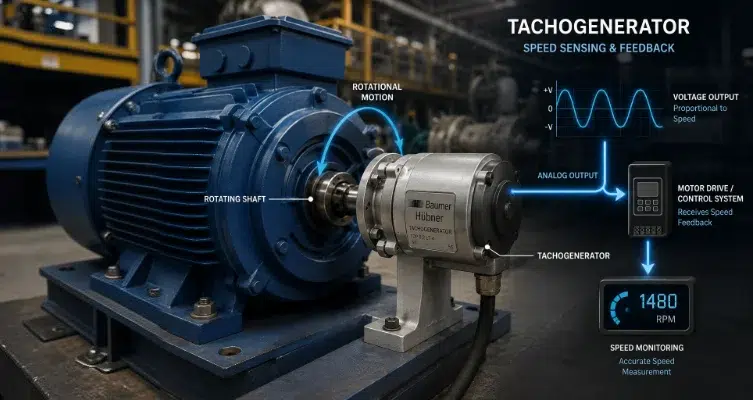
Anywhere a motor needs to run at a precise, controllable speed — a lift, a conveyor, a crane, a piece of packaging equipment — something has to tell the control system exactly how fast the shaft is turning, moment by moment. One of the simplest and most reliable ways to do that is with a tachogenerator. Despite being one of the oldest speed-sensing technologies still in daily industrial use, many engineers and technicians have never had the working principle explained in plain terms. This guide covers what a tachogenerator actually does, how it generates its signal, what it is commonly used for, and whether it can be trusted to measure speed accurately.
What Is a Tachogenerator?
A tachogenerator (often shortened to “tacho”) is a small electromechanical generator that produces an electrical output proportional to the rotational speed of its shaft. Rather than supplying power to a load, its only job is to act as a feedback sensor: it is mechanically coupled to a motor or rotating shaft, and the voltage it generates is fed back to a control system, a display, or a drive so the equipment always “knows” how fast it is turning.
Because the output is a simple analogue voltage rather than digital data that needs decoding, tachogenerators have remained a popular, low-cost, and highly reliable choice for closed-loop speed control — particularly on DC motor drives — for decades.
The Working Principle of a Tachogenerator
A tachogenerator works on the same basic principle as any electrical generator: electromagnetic induction. When a conductor moves through a magnetic field, a voltage is induced in that conductor. Faraday’s law tells us that the size of this induced voltage is directly proportional to how quickly the magnetic flux is changing — in other words, how fast the shaft is spinning.
Inside a typical tachogenerator, a rotor (either a wound armature or a permanent magnet, depending on the design) rotates inside a fixed magnetic field created by permanent magnets or field windings in the stator. As the rotor turns, it induces a voltage that rises and falls in direct, linear proportion to rotational speed. This relationship is usually expressed as:
Vo = Kt × ω
Where Vo is the output voltage, Kt is the tachogenerator constant specific to the unit (usually expressed as volts per 1,000 rpm), and ω is the angular speed of the shaft.
Because this relationship is linear across the device’s rated speed range, reading the output voltage is enough to know the exact rotational speed — no additional processing, pulse-counting, or software is required. This is what makes tachogenerators so useful in analogue control systems: the electrical signal itself is the measurement.
Tachogenerators are generally built as either DC types, which use a commutator and brushes to produce a direct current output, or AC types, which are brushless and produce an alternating output whose amplitude and frequency vary with speed. We cover these differences — and how to choose between them — in our companion guide to the different types of tachogenerators and their key features.
Why Tachogenerators Are Still Used Today
With so many digital sensing options available, it is fair to ask why a technology this old is still specified on new equipment. The answer comes down to simplicity and robustness. A tachogenerator is self-generating — it produces its own signal from the rotation itself and does not need a separate power supply to operate as a sensor. It requires no signal processing to produce a usable, real-time speed value, which keeps control systems simple and response times fast. It is also mechanically rugged, tolerant of vibration and harsh industrial environments, and straightforward to maintain or replace like-for-like on legacy equipment — all of which keeps it a cost-effective choice long after newer technologies have entered the market.
What Are Tachogenerators Used For?
Because they provide instant, continuous, easy-to-interpret speed feedback, tachogenerators are used wherever a system needs to monitor or control rotational speed in real time. Common applications include:
- Closed-loop speed control on DC motor drives, where the tachogenerator’s output is fed back into the drive to hold speed steady under varying load
- Lifts and elevators, where consistent, well-controlled speed is essential for passenger comfort and safety
- Cranes and hoists, where precise, repeatable speed control affects both safety and load handling
- Printing, packaging, and textile machinery, where multiple rotating sections must stay synchronised
- Conveyor and material handling systems, to maintain consistent line speed
- Test benches and dynamometers, where accurate, real-time speed data is needed for testing motors, engines, or drivetrains
- Wind turbines and other rotating plant, for continuous rotor speed monitoring
- Older analogue speedometers and tachometers on industrial, agricultural, and off-highway vehicles, although most modern road vehicles now use other sensor types
In short, wherever a machine needs to know its speed instantly and reliably — without waiting on a processor to calculate it — a tachogenerator is often the simplest and most dependable tool for the job.
Can a Tachogenerator Measure Speed?
Yes — measuring speed is the entire purpose of a tachogenerator. Unlike a position encoder, which tracks discrete steps or pulses that then have to be counted and converted into a speed value over time, a tachogenerator produces a continuous analogue signal whose magnitude is speed itself. This gives it a genuine advantage in fast-acting control loops: there is no delay while pulses accumulate before a speed reading becomes available, which makes tachogenerators well suited to applications where instantaneous response matters, such as motor speed regulation.
That said, tachogenerator accuracy does depend on a few practical factors. Brushed DC units are subject to gradual brush wear, which can introduce electrical noise or a small drift in accuracy over the unit’s life. Output can also vary slightly with temperature, and accuracy is only guaranteed within the manufacturer’s specified linear speed range — running a unit beyond its rated maximum speed can produce a non-linear, unreliable signal. For applications requiring very high precision or long-term accuracy with minimal maintenance, brushless AC tachogenerators or digital pulse tachometers are sometimes preferred instead.
Used within its designed range and properly maintained, however, a tachogenerator remains one of the most dependable and cost-effective ways to measure rotational speed in industrial equipment.
Choosing the Right Tachogenerator
Not all tachogenerators are built the same way, and the right choice depends on your application’s speed range, environment, and control requirements. In our companion article, we take a closer look at the different types of tachogenerators available, their key features, and where each one performs best.
If you need help specifying, sourcing, or replacing a tachogenerator for your equipment, get in touch with the Saftronics team — we can help match the right unit to your motor and drive system.
