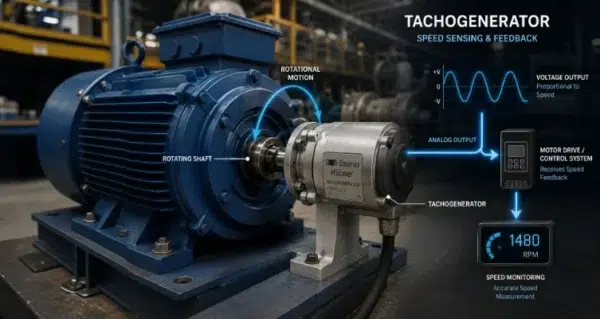
Types of Tachogenerators: Key Features and Real-World Applications
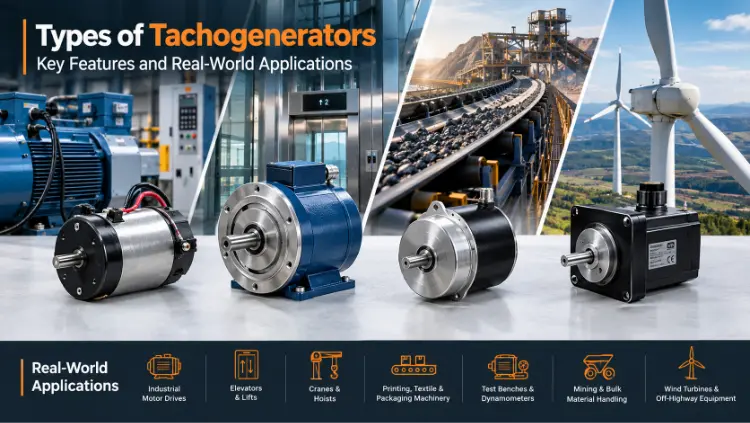
Once you understand how a tachogenerator works, the next question is usually which one to specify. Tachogenerators are not a one-size-fits-all component — the right choice depends on the speed range, environment, and control system you are working with. This guide walks through the main types of tachogenerator available, the key features worth comparing before you buy, and some real-world applications where each type earns its keep.
The Main Types of Tachogenerators
DC (Brushed) Tachogenerators
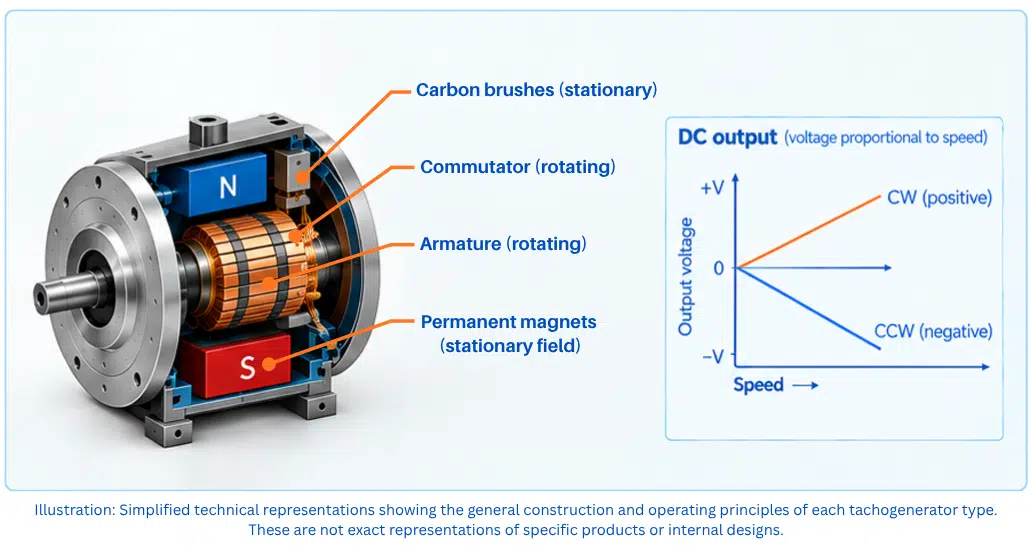
DC tachogenerators are the most widely used type in industrial motor control. A permanent-magnet rotor turns inside a fixed field, and a commutator with carbon brushes converts the generated signal into a direct current output. The key advantage of a DC design is that the output voltage reverses polarity when the shaft reverses direction — so a DC tachogenerator tells you not just how fast something is turning, but which way. This makes it a natural fit for closed-loop DC drive systems, where both speed and direction feedback are needed. The trade-off is that brushes wear over time, so DC units need periodic inspection and eventual replacement in high-duty-cycle applications.
AC (Brushless) Tachogenerators
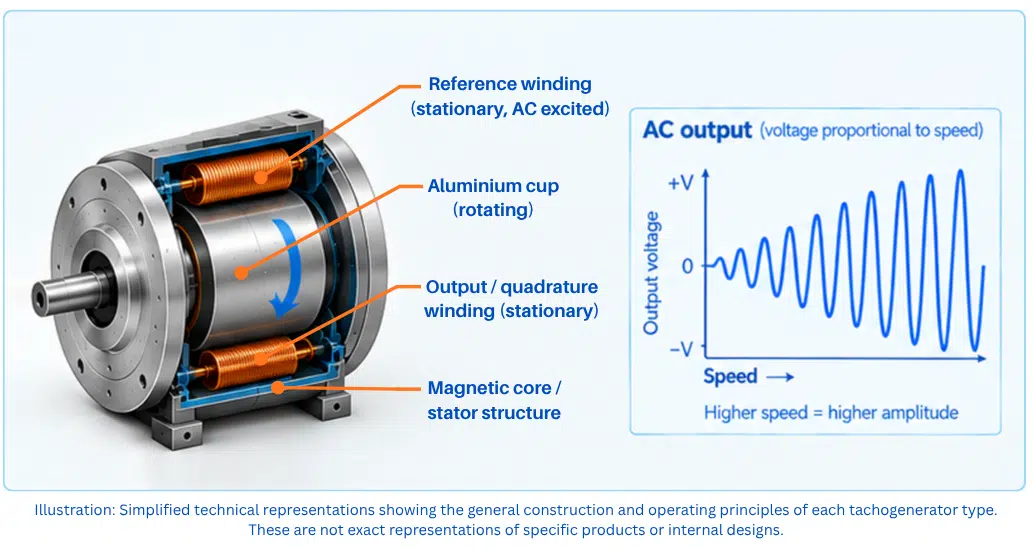
AC tachogenerators use stationary windings and a rotating permanent magnet, so there is no commutator or brushes to wear out. The output is an alternating signal whose amplitude and frequency increase with speed. Because there is nothing to wear mechanically beyond the bearings, AC tachogenerators typically offer a longer service life and lower maintenance than DC types. The trade-off is that a standard AC signal has no inherent direction — it cannot tell you whether the shaft is turning clockwise or counter-clockwise, only how fast. Where direction feedback isn’t required, AC units are often the more durable and cost-effective long-term choice.

Drag-Cup Tachogenerators
A less common but useful variant, the drag-cup tachogenerator replaces the wound armature with a lightweight aluminium cup rotating inside a wound electromagnetic stator. As the cup rotates, it generates eddy currents that produce an output signal proportional to speed. Because the cup has very low inertia compared to a wound armature, drag-cup designs respond extremely quickly to speed changes and load the driven shaft very lightly — a useful property in sensitive servo and instrumentation applications where the tachogenerator itself must not affect the dynamics of the system it is measuring.
Digital / Pulse Tachometers
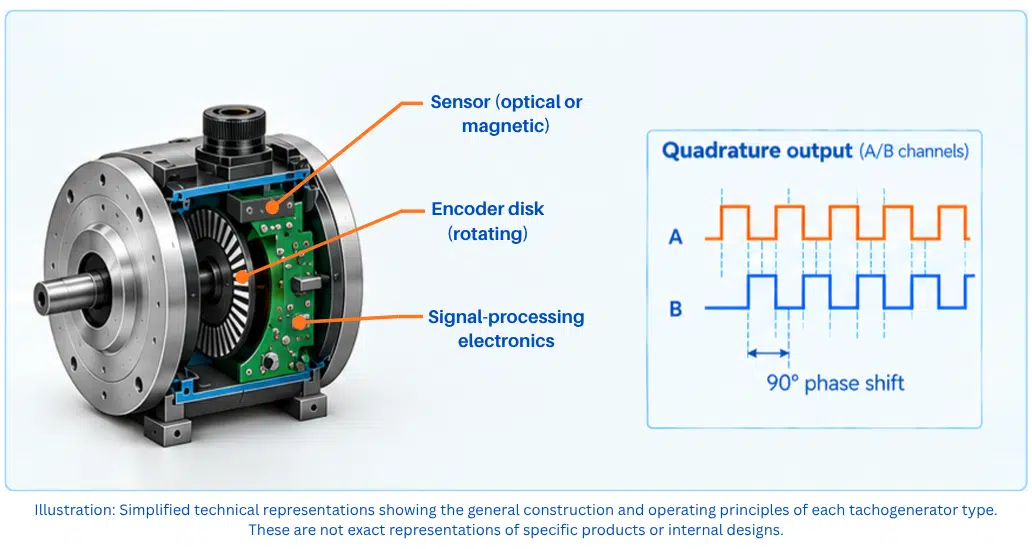
Strictly speaking, digital tachometers (sometimes built around optical or magnetic encoders) work differently to analogue tachogenerators — rather than generating a proportional voltage, they produce a train of electrical pulses as the shaft rotates, and a controller counts those pulses over time to calculate speed. They are worth knowing about because they are often considered alongside analogue tachogenerators when specifying a new system. Digital types can offer very high resolution and excellent long-term stability with no brush wear, but they need external power and signal processing to produce a usable speed value, and very low-speed readings can lag slightly while enough pulses accumulate to calculate an accurate figure.
Key Features to Consider When Choosing a Tachogenerator
Once you know which broad type suits your application, the following features will help you narrow down the right specific unit:
Getting these specifications right the first time avoids downtime later — an undersized or mismatched tachogenerator is a common (and avoidable) cause of erratic speed control on older drive systems.
Real-World Applications of Tachogenerators
Tachogenerators are unglamorous but essential components across a wide range of industries. Some of the most common applications include:
From heavy industrial plant to precision servo systems, the common thread is the same: a tachogenerator gives equipment a simple, direct, and dependable way to sense its own speed.
Finding the Right Tachogenerator for Your Application
With several types available and a range of features to weigh up, choosing the right tachogenerator is easiest with some guidance from people who work with these components every day. Get in touch with the Saftronics team to talk through your speed sensing requirements — we can help you specify, source, or replace a tachogenerator that matches your motor, drive, and environment.