Heater Controllers

The Advantages of Thyristor Power Controllers for Industrial Heaters
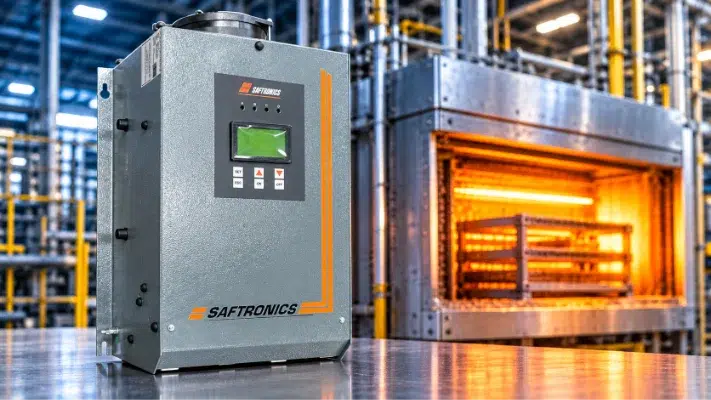
Thyristor power controllers give industrial heaters tighter temperature control, lower energy use and longer element life than traditional contactor switching. For any plant that relies on electric heating, from ovens and furnaces to plastics lines and process tanks, that difference shows up in product quality, maintenance costs and the monthly electricity bill.

Electric heating elements are simple, but controlling them well is not. Switch them too coarsely and temperatures swing above and below the setpoint. Switch them too often with mechanical contacts and those contacts wear out. A thyristor power controller solves both problems.

What is a Thyristor Power Controller?

A thyristor power controller is a solid-state switch that regulates how much electrical power reaches a heating load. It uses thyristors, also called SCRs (silicon-controlled rectifiers), instead of mechanical contacts. A temperature controller or PLC sends a reference signal, typically 4–20mA or 0–10V, and the thyristor unit delivers the matching percentage of power to the heater.

There are two main ways of doing this:

  • Phase-angle firing switches the thyristors on part-way through each half-cycle of the AC supply. This gives smooth, continuously variable power. It suits loads that need fine control or soft starting, such as transformer-coupled heaters and elements whose resistance changes sharply with temperature.
  • Burst firing (zero-cross switching) passes complete AC cycles on and off. For 40% output, the controller passes 4 cycles out of every 10. Because switching happens at zero voltage, it creates very little electrical noise and is ideal for standard resistive heating banks.

The Key Advantages

  • Precise, stable temperature control
    Contactors can only switch a heater fully on or fully off, usually over cycles of many seconds. Temperatures overshoot and undershoot the setpoint as a result. A thyristor controller adjusts power in fractions of a second, so the process temperature stays tight to the setpoint. That means more consistent product quality and less scrap, whether you are curing coatings, extruding plastic or heat-treating metal.
  • No moving parts, far less maintenance
    Mechanical contactors wear out. Every switching operation erodes the contacts, and fast cycling for better control only speeds that up. Thyristors are solid-state, with no contacts to burn, pit or weld. They can switch millions of times without wear, which cuts maintenance, spares and unplanned stoppages.
  • Longer heating element life
    Repeated full-power switching causes thermal shock, expanding and contracting elements on every cycle. Thyristor control delivers power gradually and evenly, reducing that stress. Soft-start ramps also limit the inrush current that cold elements draw, especially low-resistance materials such as molybdenum disilicide, silicon carbide and tungsten. Elements last longer and fail less often.
  • Lower energy use
    Because the heater gets exactly the power the process needs, there is no wasted energy from overshooting the setpoint. Tighter control also allows processes to run closer to their optimum temperature. With South African electricity tariffs continuing to rise, every kilowatt-hour saved goes straight to the bottom line.
  • Protection for the heater and the supply
    Modern thyristor controllers monitor the load continuously. Features such as current limiting, overcurrent, phase-loss and undervoltage protection, current-imbalance detection and partial-load-failure alarms catch problems early, before they become costly breakdowns.
  • Silent, clean switching
    There is no contactor chatter or arcing. Burst-firing controllers switch at the zero crossing of the voltage waveform, which keeps electromagnetic interference to a minimum and makes them well suited to sensitive environments.
  • Easy integration with automation
    Thyristor controllers accept standard analogue signals (4–20mA, 0–5V, 0–10V) and, in many cases, digital communications such as Modbus RS485. They plug straight into PLC and SCADA systems for remote setpoints, monitoring and fault reporting.

Where Thyristor Heater Control Pays Off

Thyristor power controllers are used wherever electric heating is critical to the process, including:

  • Industrial ovens, furnaces and kilns
  • Resistance heating banks and process heaters
  • Plastics processing and extrusion lines
  • Chemical and process tank heating
  • Food processing equipment
  • Drying and curing systems
  • Transformer-coupled heating systems

Our Solutions

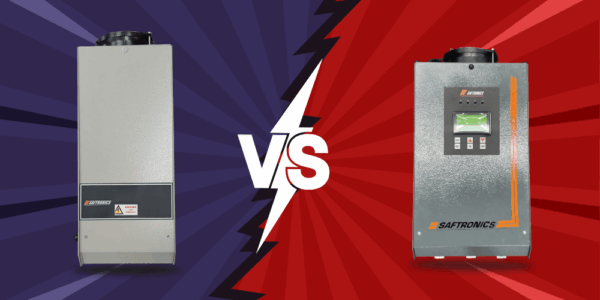
DSH6 Phase-Angle Heater Controller

Saftronics DSH6
Phase Angle

Saftronics SH4 Heater Controller

Saftronics SH4
Burst Firing

Related Posts